









WordPress Security in 2026: Supply Chain Attacks, 5-Hour Exploits & Blockchain Malware
⚠️ WordPress security in 2026 is a race against time. Attackers are no longer just scanning for outdated plugins. They are buying their way into trusted update pipelines, exploiting vulnerabilities within hours of disclosure, and using blockchain-based infrastructure to keep malware alive longer.
If your current strategy is still “update plugins and move on,” that’s not a strategy. That’s wishful thinking.
📌 In this guide: plugin risk, the 5-hour exploit problem, supply chain compromise, EtherHiding, how to secure WordPress in 2026, and the best next steps for site owners who actually want to stay standing.
📊 WordPress Security by the Numbers
The threat landscape has changed fast, and not in a good way.
- 11,334 vulnerabilities discovered in one year
- 91% of weaknesses come from plugins, not WordPress core
- 5 hours is the rough window before attackers begin mass exploitation
- Many vulnerabilities are disclosed before a patch is ready
- Paid software is not automatically safer than free software
👉 The real issue is not WordPress itself. The real issue is the ecosystem orbiting around it.
🔗 Next read: Why WordPress Plugin Vulnerabilities Are Exploding
⏱️ The 5-Hour Problem: Why Updating Plugins Is No Longer Enough
For years, the standard WordPress advice was simple: keep plugins updated.
That advice is still directionally right, but it is no longer enough on its own.
- Attackers monitor public disclosures in real time
- Exploit code gets weaponized almost immediately
- Site owners are slower than automated attack systems every single time
By the time many admins even hear about a plugin issue, the attack traffic has already started.
This is the new reality: patching is necessary, but patching is reactive. You also need a protection layer that buys you time.
🛡️ What actually helps here?
Start with strong hardening practices, reputable security tooling, and a serious WAF. If you’re building out your stack, bookmark Best WordPress Security Plugins in 2026 and Best WAF for WordPress in 2026.
📋 Also useful: WordPress Security Checklist for 2026
🔌 Plugins Are the Real Attack Surface
WordPress core is not where most of the chaos comes from. Plugins are.
Every plugin adds:
- new code
- new permissions
- new vendor risk
- new maintenance dependencies
And in 2026, attackers know exactly where the leverage is.
💡 The premium plugin myth
A lot of site owners still assume a paid plugin is safer than a free one. That sounds nice. It’s just not a law of physics.
Some premium plugins are excellent. Some are under-scrutinized, over-trusted, and installed across large fleets of websites. That makes them prime targets.
Translation: trust is now part of the attack surface.
✅ Plugin audit checklist
- Delete inactive plugins completely
- Review update history and vendor reputation
- Remove anything you do not absolutely need
- Check whether a plugin overlaps with another tool you already use
- Treat abandoned or slow-moving plugins as liabilities
🧬 Supply Chain Attacks: Buying Trust Instead of Breaking It
The modern attacker does not always need to “hack in.” Sometimes they just buy their way in.
That is what makes plugin portfolio compromises so nasty. Instead of attacking every individual site, an adversary compromises the trusted delivery mechanism itself.
That means:
- a plugin changes hands
- malicious code gets inserted quietly
- the payload stays dormant
- automatic updates do the distribution work for the attacker
That is not just malware. That is a business-model-level exploit.
🚨 Why this matters for SEO too
Many of these compromises are not loud. They are designed to be quiet enough that site owners miss them while search engines and visitors get manipulated experiences.
Common outcomes include:
- SEO spam injections
- cloaked redirects
- hidden payloads inside core configuration files
- reputation damage you don’t notice until rankings tank
🔍 Deeper dive: What Is EtherHiding? Blockchain Malware Explained
⛓️ EtherHiding and Blockchain-Based Malware Infrastructure
One of the uglier evolutions in website security is the use of blockchain infrastructure for command-and-control behavior.
Old-school malware depended on centralized servers and domains. Those could be blocked, suspended, sinkholed, or seized.
Blockchain-backed delivery changes the game:
- instructions can live in smart contracts or related blockchain data
- malware can query public endpoints for fresh instructions
- attack infrastructure becomes harder to disrupt
That does not make it magical. It makes it annoyingly resilient.
For defenders, the lesson is simple: stop looking only at inbound traffic. Start watching outbound behavior too.
🔍 Smart move
If your WordPress site is making unusual outbound calls to services it has no business talking to, that deserves investigation. Don’t sleepwalk past that.
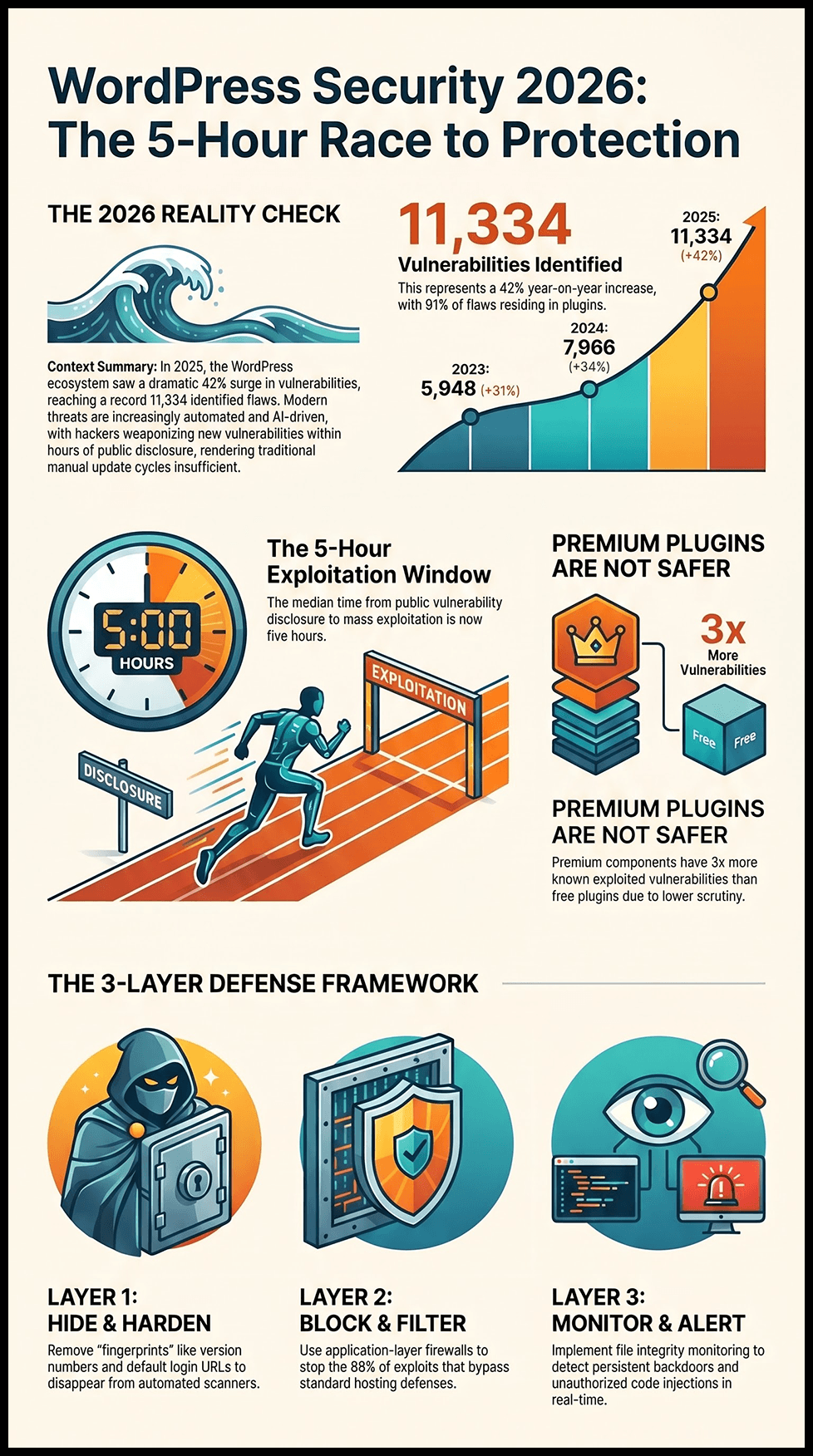
Modern WordPress vulnerabilities are exploited within hours of disclosure. This visualization shows how fast attackers move in 2026.
🛡️ How to Secure WordPress in 2026
This is where theory ends and execution starts.
1️⃣ Use a real WAF
A strong WAF helps close the gap between disclosure and patch deployment. If you plan to compare options, build or link to Best WAF for WordPress in 2026.
According to CISA, modern web threats are evolving faster than patch cycles.
2️⃣ Use reputable security plugins
Strong security plugins give you visibility, malware scanning, change detection, brute-force protection, and hardening controls that too many sites still ignore.
3️⃣ Lock down file permissions
- Files: 644
- Folders: 755
wp-config.php: as locked down as your environment allows
4️⃣ Disable PHP execution in uploads
The uploads directory should store media, not executable surprises.
5️⃣ Kill weak admin hygiene
- remove default-style usernames
- enforce strong passwords
- enable 2FA
- limit login attempts
6️⃣ Monitor outbound traffic
Inbound-only security thinking is outdated. Watch where your server talks to the outside world.
7️⃣ Keep off-site backups
Not “hopefully recoverable” backups. Not backups on the same box. Real off-site recoverable backups.
🧰 Recommended next reads
Best WordPress Security Plugins in 2026 · Best WAF for WordPress in 2026 · WordPress Incident Response Plan
Start with the right stack: security plugins, WAF, and monitoring tools.
→ See recommended setup here
🔗 Related WordPress Security Resources
This is where the moat gets built. Don’t publish one article and walk away. Publish the cluster.
- Best WordPress Security Plugins in 2026
- Best WAF for WordPress in 2026
- What Is EtherHiding? Blockchain Malware Explained
- Why WordPress Plugin Vulnerabilities Are Exploding
- WordPress Security Checklist for 2026
- How to Secure wp-config.php Properly
- WordPress Incident Response Plan
- How to Monitor Outbound Traffic on WordPress Servers
❓FAQ: WordPress Security in 2026
Is WordPress itself insecure?
No. The larger risk usually comes from plugins, themes, weak credentials, bad hosting hygiene, and poor monitoring.
Are paid WordPress plugins safer than free ones?
Not automatically. Some paid plugins are excellent. Some are simply more trusted and therefore more attractive to attackers.
Why does a WAF matter so much now?
Because exploit timelines are compressed. A WAF helps absorb the gap between public disclosure and vendor patch availability.
What are the most important first steps?
Reduce plugin sprawl, enable 2FA, deploy a WAF, use strong security plugins, harden permissions, and keep clean off-site backups.
Should I monitor outbound traffic on my website?
Absolutely. Modern compromises often show up in unusual outbound connections long before a site owner notices visible damage.
🚀 Final Take
WordPress is not dead. WordPress security is not hopeless. But the old “install a plugin and forget it” mindset is dead as hell.
2026 security is about speed, visibility, discipline, and layered defense.
If you want your site to survive, rank, and make money, you need to treat it like an operating asset, not a neglected side project.
💼 Want the serious setup?
Build the stack, build the cluster, and build the habit. That’s how small WordPress sites stop getting treated like easy prey.